
The Disclaimer Is Not the Safeguard
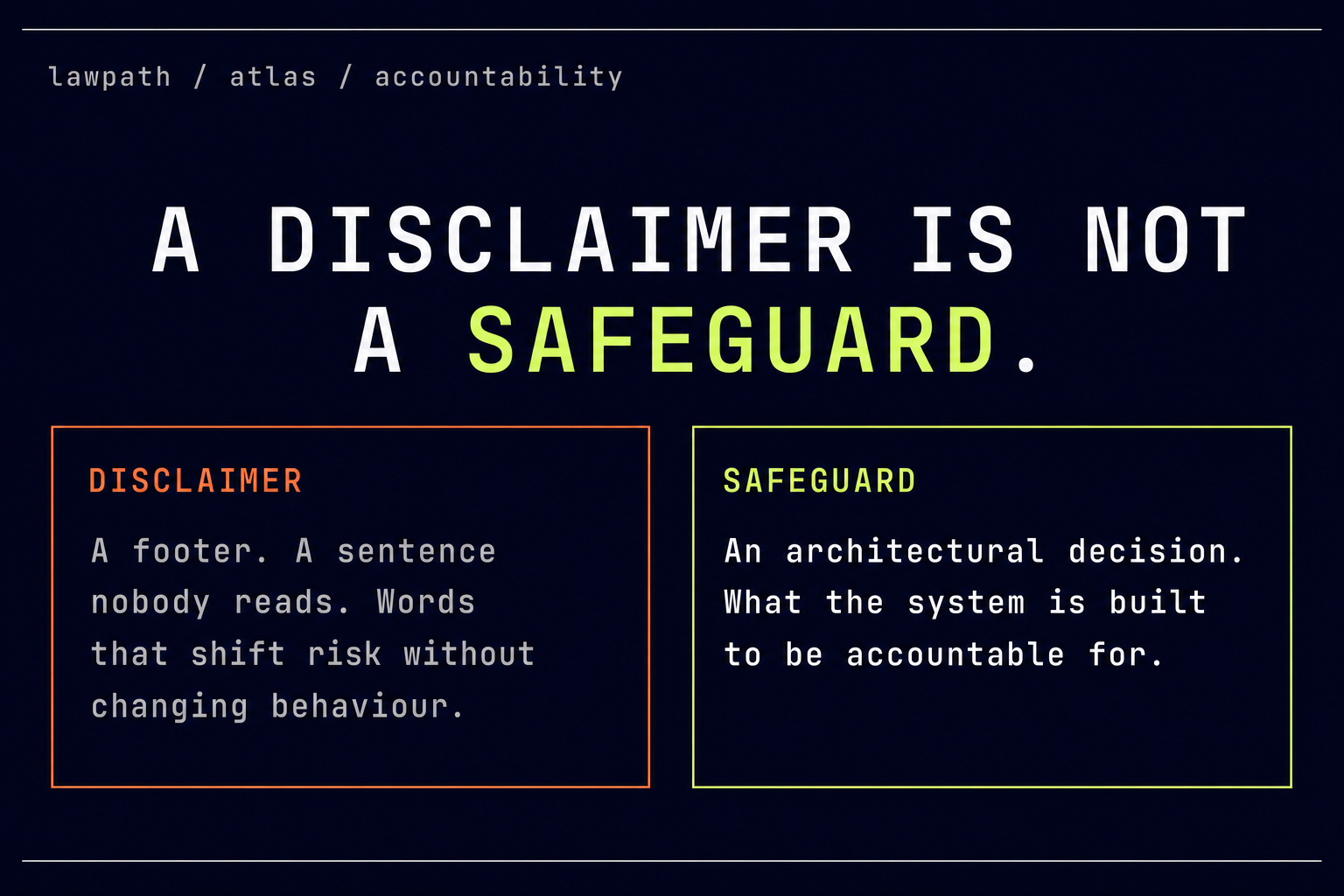
Responsible AI is not a footer or a press release. It is an architectural decision, a posture, and ultimately a description of what your company is willing to be accountable for. A reflection on what we owe small business owners when their legal, tax, and accounting advisor is us.
Every AI built into someone’s legal and accounting life inherits a responsibility its founders never signed up for.
The moment a small business owner opens a chat window and asks “can I sack my employee for this,” or “do I have to pay super on this contractor,” or “is this expense deductible,” the AI is already in a relationship that did not exist five years ago. They are not asking a search engine. They are asking something they trust.
Whether or not we earned that trust is a separate question.
Whether we honour it is the only one that matters.
This is not a footer
It is easy to think of responsible AI as the small print. The disclaimer at the bottom of the response. The “this is not legal or financial advice” line. The compliance review just before launch.
That is the easy part.
It is also the part that does almost nothing.
A disclaimer does not stop a model from being too confident. It does not stop it from improvising. It does not stop a frustrated owner, three messages deep at 11pm on a Tuesday, from acting on something the AI should never have offered in the first place.
The disclaimer is not the safeguard. The system is the safeguard, or there isn’t one.
What we are actually answering
When someone asks Lawpath Atlas about a contract, a BAS, a Director ID, a payroll obligation, or whether their structure still makes sense now that they have a co-founder, they are not asking us to be impressive. They are asking us not to ruin their week.
The cost of a smooth, confident, slightly wrong answer is not measured in NPS. It is measured in unfair dismissal claims, ATO penalties, ASIC late fees, missed BAS lodgements, super guarantee charges, contracts that say something the founder never meant to agree to, and the slow erosion of a business that was already operating on thin margins.
That is the floor we have to design above.
Not the floor of “the model sounded helpful.” The floor of “the owner is better off because they came to us.”
Restraint as a feature
The strange thing about building a responsible AI is that most of the work is restraint.
Not generating the answer the user wants, when the answer they want is wrong.
Not pretending to have a view on an active dispute.
Not posturing as a lawyer or an accountant when the question has crossed the line into actual advice.
Not guessing at a tax treatment when the answer has real money attached to it.
Not flattering a founder into thinking their idea is fine when the structure is, gently, a problem.
The most important behaviours of Lawpath Atlas are the ones where it stops. Where it says, in effect, this part is not mine to answer, and routes the conversation to a lawyer, an accountant, or a tax agent who can actually be accountable for the response.
A model that cannot stop is a liability dressed as a product.
The architecture is the position
People sometimes ask whether responsible AI is a values question or an engineering question. It is both, but the engineering is where the values become real.
In Lawpath Atlas, the things we care about are not in a marketing deck. They are in the prompt hierarchy, where user safety and professional boundaries override helpfulness, which overrides commercial considerations, in that order, every time. They are in the complexity classifier that decides whether a question is general education or specific advice, and whether it belongs to a lawyer, an accountant, or a tax agent. They are in the escalation paths that bring a human professional into the loop when the matter is genuinely hard. They are in the knowledge pipeline that refuses to let last year’s super guarantee rate, marginal tax thresholds, or instant asset write-off limits masquerade as this year’s.
These are not policies. Policies can be talked around.
These are constraints. The system cannot violate them, even if you ask it nicely.
The part that surprised me
When you write down what your AI is not allowed to do, you start writing down what your firm is not willing to be.
Do not pretend to be a lawyer.
Do not pretend to be an accountant.
Do not invent a number, a rate, or a deadline.
Do not promise an outcome.
Do not exploit a worried founder at 11pm.
Be honest about uncertainty.
Defer to a human when the stakes deserve one.
At some point you realise the document is not really about the AI. It is about the kind of company you want to put in front of 650,000 small business owners.
Lawpath Atlas is the most concrete statement of that company we have ever shipped.
Why this is hard, and why it is the job
There is a version of this work that is much easier. Build a chatbot. Train it to be helpful. Add a disclaimer. Ship it. Let the user figure out where the edges are.
That version is not responsible. It is just fast.
The harder version is to decide, before any of the code is written, what the AI is allowed to be sure about, when it must hesitate, who it must hand off to, and what kinds of help are actually harm in disguise.
We do not get all of this right. Some of the harness is still being built. Some of the boundaries are still being discovered. Models change. Customers change. Regulation changes.
But the posture does not change.
The posture is that this is a quasi-advisor in someone’s working life, and the people building it have a duty of care.
The real question
If you are building AI for small business, the interesting question is not whether your model is the smartest one on the leaderboard.
It is whether your system is the one you would be comfortable putting in front of your own family’s business at the worst moment of their year.
That is the bar Lawpath Atlas is being built against.
Not because we have solved responsible AI.
Because we have not.
Uncertainty is exactly when posture matters most.
Lawpath Atlas is available for all Lawpath customers. To learn more, visit lawpath.com.au/lawpath-atlas.