
Building the Always-On AI for Small Business
Why we believe the future of professional services lies in AI that works proactively - finding problems before they happen so business owners can focus on what they do best.
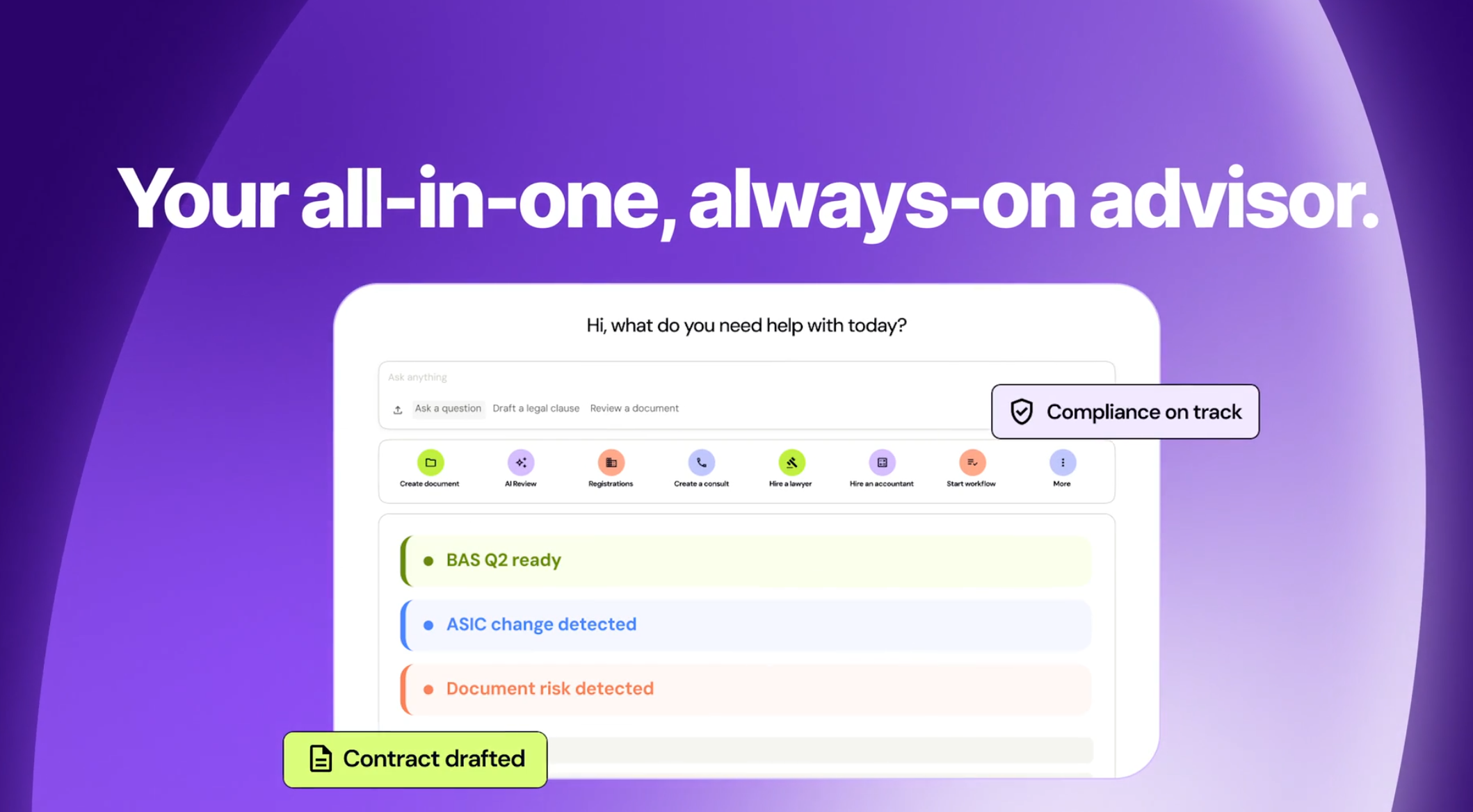
The Shift from Reactive to Proactive
For decades, small business owners have navigated a familiar pattern: something goes wrong, they scramble to fix it, and they hope they caught it in time. A compliance deadline slips. A contract clause comes back to bite them. A tax obligation surprises them at the worst possible moment.
This reactive model has been the default because professional services (legal, accounting, compliance) have historically been structured around billable hours and crisis response. The incentives weren’t aligned with prevention.
We believe that’s about to change, and we’re building the technology to make it happen.
The $160 Billion Problem
The compliance burden on Australian small businesses isn’t just inconvenient. It’s economically devastating. According to the Australian Institute of Company Directors, Commonwealth regulatory compliance alone costs businesses $160 billion annually (5.8% of GDP), more than double the $65 billion recorded in 2013. And that figure doesn’t include state and local government compliance costs.
The Australian Chamber of Commerce and Industry reports that 61% of small business owners spend over $20,000 annually on compliance, with 42% stating regulation negatively impacts their operations. The volume of federal regulation has doubled since 2000 while the pages of regulation have tripled, coinciding with Australia’s lowest productivity growth in 60 years.
Meanwhile, what the Small Business Ombudsman calls “white tape” (obligations imposed by large corporations like modern slavery clauses, climate disclosure requirements, and data requests) adds yet another layer that small businesses lack resources to handle.
The cognitive load compounds the financial one. Business owners carry a constant mental inventory of things they might have forgotten: Did I lodge that BAS? Is my company registration up to date? Should I have updated that contractor agreement when the law changed? This background anxiety is exhausting, even when nothing actually goes wrong.
The Agentic AI Moment
The technology industry is in the middle of what McKinsey calls “the largest organizational paradigm shift since the industrial and digital revolutions”: the emergence of agentic AI. Unlike the first wave of AI assistants that waited for questions, agentic systems perceive their environment, reason about it, and take action autonomously.
Gartner predicts that 15% of day-to-day work decisions will be made autonomously by agentic AI by 2028, up from effectively none in 2024. Deloitte’s 2026 Tech Trends report identifies the shift from copilots to autonomous agents as the defining enterprise technology trend of the year.
But here’s the critical gap: almost all of this investment targets large enterprises. The 2.5 million small businesses in Australia, the ones with the highest compliance burden relative to their resources, have been largely left out.
This is the problem we set out to solve with Lawpath Atlas.
An Agent That Already Knows Your Business
Most AI tools start from a blank slate. You type a question, you get a generic answer, and the next conversation starts from zero again. Atlas is fundamentally different. Every interaction spins up a dedicated AI agent that has already performed progressive due diligence on your business before you ask a single question.
Research Before the First Conversation
When you join Lawpath, Atlas does what any good professional would do before a first meeting: homework. Using multiple research providers (web intelligence services, company data validation, public registry lookups), the system builds a structured understanding of your business. Your industry classification down to the ANZSIC code. Your business structure. Your location and the state-specific regulations that apply. Your likely compliance obligations based on businesses like yours.
This isn’t a form you fill out. It happens automatically, using publicly available information, so that from your very first interaction Atlas can provide genuinely relevant guidance rather than asking you twenty questions it could have answered itself.
A Profile That Learns, Not Just Stores
From that initial research, your agent’s understanding deepens continuously. Every document you create is classified: what type of agreement it is, who the parties are, what obligations it creates, and whether it’s a binding contract requiring signatures or administrative paperwork. Every consultation you book enriches the picture with topics discussed and follow-up actions. Every question you ask reveals needs you might not have articulated as formal requirements.
The system synthesises all of this into what we call the customer 360: not a static database record, but a living, AI-generated narrative of your business situation. Where you are in your journey. What you’ve done. What you’re likely to need next. It’s the kind of deep contextual understanding that previously required a long-standing relationship with a trusted advisor, built automatically and updated in real time.
How Your Agent Actually Works
The technical architecture behind your Atlas agent is substantially more sophisticated than most AI products on the market. Here’s what happens when you interact with it.
Intelligent Prompt Assembly
Your agent doesn’t receive a generic set of instructions. Before every interaction, a prompt orchestration system dynamically assembles a tailored context from multiple sources. It pulls your business profile, your entitlements, your compliance status, your consultation history, and your document activity. It retrieves relevant legal content through semantic search. It checks for recent regulatory changes that affect your industry.
This assembled context is structured into static layers (Lawpath’s legal knowledge, behavioural rules, professional boundaries) and dynamic layers (your specific situation, your history, the current date’s compliance implications). The static layers are cached for performance; the dynamic layers are rebuilt fresh for every conversation.
The result: when you ask a question about, say, hiring your first employee, your agent already knows your business structure, your state, your industry’s award obligations, and whether you’ve already created an employment agreement. It skips the generic preamble and gets straight to what you actually need.
Multi-Model Orchestration
Your agent doesn’t rely on a single AI model. A complexity classifier evaluates every interaction and routes it to the optimal model for the task. Simple factual questions (“When is my next BAS due?”) get fast, direct responses from lightweight models. Complex legal analysis (“How does the new payday super legislation affect my contractor arrangements?”) engages deeper reasoning models with extended thinking capabilities and real-time web search to find the latest regulatory guidance.
We orchestrate across multiple AI providers and model families. Some are optimised for speed. Others for depth of reasoning. Others for specific domain expertise in Australian law and accounting. Batch processing models handle bulk analysis at lower cost without sacrificing quality. The routing is invisible to you, but it means you always get the right tool for each question.
Tool Use: Not Just Answering, but Doing
This is where Atlas diverges most sharply from conventional chatbots. Your agent has access to tools it can invoke autonomously during a conversation.
When you mention hiring an employee, the agent doesn’t just explain employment law. It calls a document search tool to find the relevant employment agreement template, checks whether you’ve already created one, and recommends the right starting point. When you ask a complex question about recent legislative changes, the agent can search the web in real time for the latest guidance from the ATO, Fair Work, or ASIC, then synthesise what it finds with Lawpath’s curated knowledge.
These tool calls happen in a multi-round loop. The agent reasons about what information it needs, calls the appropriate tool, evaluates the result, and decides whether it needs more information before responding. This is agentic behaviour in the true sense: the AI is autonomously deciding how to gather and use information to help you, not just pattern-matching against a static knowledge base.
Three Layers of Knowledge
When your agent responds, it draws on three distinct knowledge sources, dynamically assembled and ranked:
-
Curated legal knowledge: Lawpath’s maintained library of legal content, document templates, and platform guidance, retrieved through semantic search so the most relevant content surfaces regardless of exact keyword matches
-
Supplementary intelligence: real-time external knowledge from professional consultations, regulatory updates, and industry guidance. This layer is filtered by a relevance threshold and ranked by recency, so recent policy changes are prioritised over older general content
-
Your personal context: conversation memories, past consultation transcripts, documents you’ve created, and your explicitly stated preferences. If you’ve told Atlas something about your business that contradicts older profile data, your correction takes priority
These layers are assembled fresh for each interaction, with temporal awareness built in. The system knows the current financial year, upcoming quarterly deadlines, and which regulatory changes are active versus upcoming. When you ask about “this year’s” tax obligations, it knows exactly which year you mean and which deadlines have passed.
Proactive, Not Reactive
The most important thing Atlas does is work when you’re not looking.
The system continuously monitors signals across your business and the regulatory environment. When your ASIC annual review is approaching, Atlas surfaces it before it’s overdue. When legislation changes that affects your employment agreements, the system flags which documents may need updating. When your business reaches a stage where you’re likely to need new legal protections (hiring your first employee, taking on a co-founder, expanding interstate), Atlas proactively recommends the right next steps.
This is powered by what we call the next-best-action engine. It collects signals from across the platform, batches them for AI analysis, and produces structured recommendations grounded in your specific profile, your industry patterns, and the collective experience of 650,000+ businesses. Each recommendation comes with the reasoning behind it and a clear path to action, whether that’s creating a document, booking a consultation, or simply being aware of an upcoming obligation.
The industry data supports this approach. Hyperproof’s 2026 benchmark report found that organisations using integrated, automated risk management experience compliance breach rates of 27%, compared to 50% for those using ad-hoc approaches. The shift from retrospective review to real-time, proactive monitoring isn’t just more convenient. It’s measurably safer.
Purpose-Built Models for Australian Law
Most AI products rely entirely on general-purpose language models. These models are trained on the broad internet: English-language web pages, books, forums, code. They know a little about a lot. But they know almost nothing about Australian-specific legal frameworks, current tax rates, ASIC compliance requirements, or the nuances of how the Fair Work Act applies to casual employees in different industries.
We’re taking a different approach. We’re training our own domain-specific AI models, fine-tuned specifically for Australian legal and accounting contexts.
Why Fine-Tuning Matters
General-purpose models, even the most capable ones, score poorly on Australian legal knowledge tests. In our internal benchmarks, leading commercial models achieved less than 50% accuracy on questions about Australian business law. They hallucinate pricing, invent legal concepts, and confidently state incorrect thresholds.
The solution is a hybrid approach: fine-tuning combined with retrieval-augmented generation (RAG). Fine-tuning bakes in the response style, tone, Australian English conventions, and behavioural guardrails. RAG provides current information at inference time, so the model always references the latest tax rates, legislative changes, and compliance deadlines rather than relying on stale training data.
Our fine-tuning pipeline draws on tens of thousands of real conversations between Atlas and Australian business owners, curated for quality and balanced across topics: employment law, company formation, tax obligations, contracts, and compliance. We supplement this with expert-validated examples covering critical knowledge checkpoints, edge cases, and safety behaviours like prompt injection defence and out-of-scope handling.
The Right Model for Every Task
Fine-tuning also enables us to optimise for cost and latency without sacrificing quality. A compact, domain-specific model that deeply understands Australian law can outperform a much larger general-purpose model on the questions that matter to our customers, while responding faster and costing a fraction as much to run.
This creates a practical pathway to making sophisticated AI accessible to small businesses at a price point that works, rather than reserving it for enterprises with large API budgets.
The training pipeline is continuous. As new legislation passes, as we observe new question patterns, as our advisors surface new edge cases, we retrain and redeploy. The model improves with every cycle, getting better at the specific domain it needs to serve.
A Knowledge Base That Updates Itself
A legal AI is only as good as its knowledge. Tax rates change. New legislation passes. Compliance requirements shift. An AI trained on last year’s data is already wrong about this year’s obligations.
Atlas solves this with an automated knowledge ingestion pipeline that runs weekly. The system scrapes authoritative Australian tax, legal, and accounting sources, including publications from major advisory firms and specialist tax educators. It extracts structured knowledge from each article using AI: policy updates with effective dates and impact assessments, professional resources with links and descriptions, and industry intelligence with trend analysis and timeframes.
Each extracted insight is embedded into a vector knowledge base using purpose-built legal embeddings. The system deduplicates automatically, merging corroborating insights rather than creating duplicates, with newer sources taking precedence over older entries.
The result is a knowledge base that stays current automatically. When the ATO announces new focus areas for compliance audits, or when super guarantee rates change, or when a new Modern Award variation takes effect, that information flows into Atlas’s knowledge within days, not months. Your agent’s answers reflect current law, not last year’s training data.
Built for Trust
In professional services, accuracy isn’t optional. A missed deadline, an incorrect legal interpretation, or a flawed tax calculation can have serious consequences. Building a system that business owners can genuinely trust required deliberate architectural choices.
The system knows what it doesn’t know. Atlas maintains a strict separation between general legal education (which it can provide confidently) and specific professional advice (which it escalates to human experts). A complexity classifier evaluates every interaction and identifies when a matter requires professional judgment rather than AI-generated guidance.
Professional boundaries are enforced at the architecture level. The system’s core identity and behavioural rules are encoded in a structured prompt hierarchy with explicit priority ordering. User safety and professional boundaries always override helpfulness, which always overrides commercial considerations. These aren’t guidelines; they’re hard constraints that the system cannot override regardless of how a question is framed.
Human experts are in the loop for complex matters. When Atlas detects genuine risk or complexity (active disputes, intersecting legal issues, significant financial exposure), it escalates with full context to a human professional. The AI does the preparation; the human provides the judgment.
Continuous validation against real outcomes. Our models are tested against actual business outcomes, not just synthetic benchmarks. When the system predicts that a business needs a specific type of support, we measure whether that prediction was accurate. This feedback loop keeps the system honest and improving.
The Road Ahead
We’re still early in this journey. The technology is advancing rapidly, and we’re continuously expanding what Atlas can monitor, predict, and act upon.
Our current focus areas include deeper integration with government systems for real-time compliance monitoring, richer semantic understanding of legal documents, more sophisticated next-best-action generation that anticipates needs further in advance, and expanded advisor copilot capabilities that make every human consultation more valuable.
What we’ve built with Atlas represents our best current thinking on how agentic AI should work for small business. It’s already helping over 650,000 Australian businesses stay on top of their legal, tax, accounting, and compliance obligations. But we know there’s much more to do.
The businesses of the future won’t be the ones that work hardest on administration. They’ll be the ones that work smartest, with AI agents working continuously in the background, finding problems before they happen, so owners can focus on what they actually set out to do.
That’s the future we’re building toward.
Lawpath Atlas is available for all Lawpath customers. To learn more, visit lawpath.com.au/lawpath-atlas.