
Introducing the New Standard in Legal Document Drafting for Australian Business
How Lawpath's AI-powered document editor is transforming the way Australian businesses create, review, and refine legal documents with intelligent clause suggestions, real-time risk assessments, and personalised legal guidance.
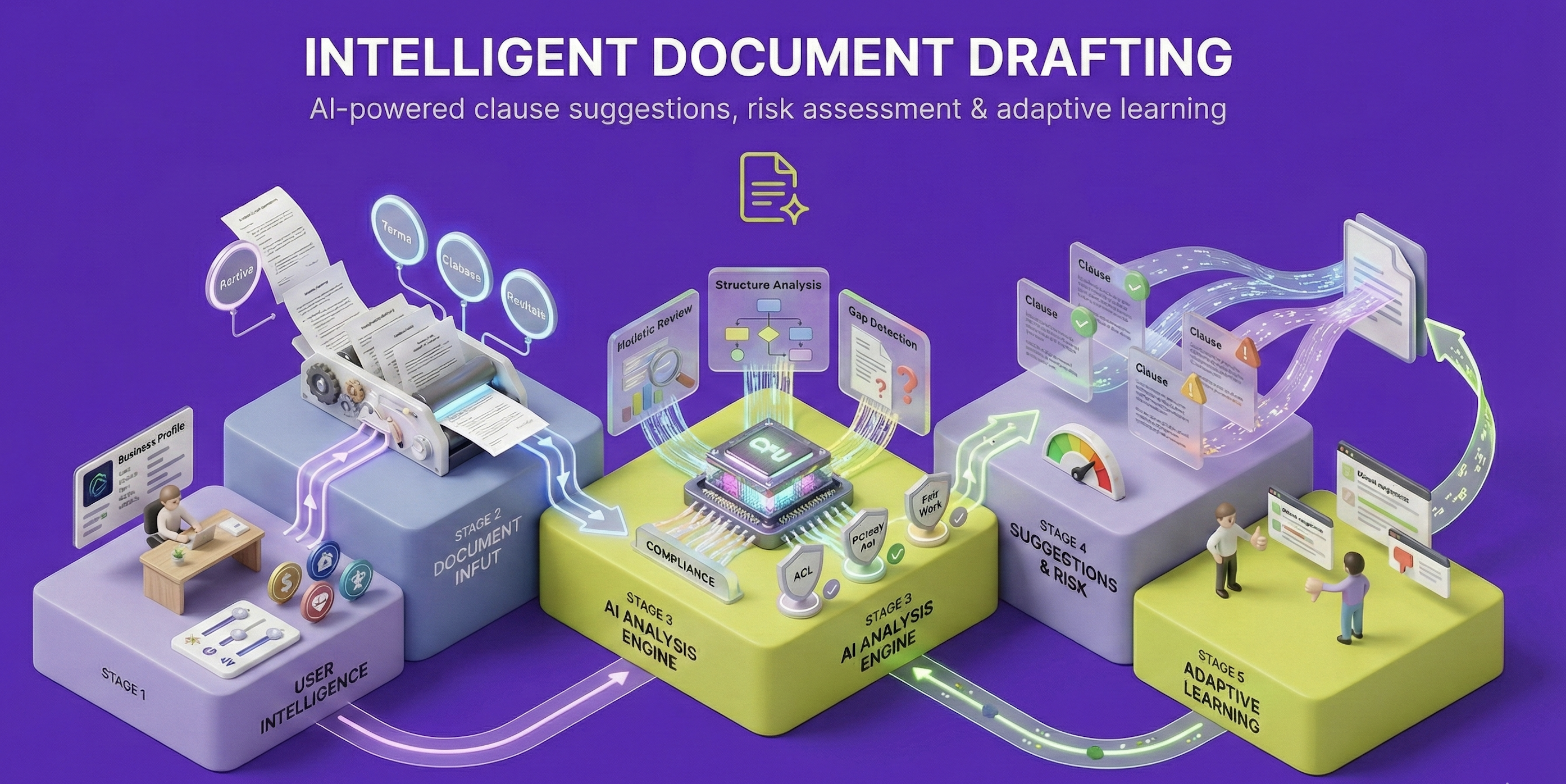
Legal document drafting has traditionally been a time-consuming, expensive, and often anxiety-inducing process for Australian business owners. Whether you’re creating an employment agreement, drafting a service contract, or reviewing a supplier agreement, the stakes are high and the complexity can be overwhelming.
Today, we’re announcing what we believe represents a fundamental shift in how Australian businesses approach legal documentation: the Lawpath AI Document Editor.
The Problem We Set Out to Solve
For years, we’ve heard from our customers about the challenges they face:
“I don’t know what I don’t know”: Business owners often lack the legal expertise to identify gaps or risks in their documents.
“I can’t afford to have a lawyer review every contract”: Traditional legal review is cost-prohibitive for many SMEs.
“I need this done yesterday”: Business moves fast, but thorough legal review typically doesn’t.
“Generic templates don’t fit my situation”: Off-the-shelf documents often miss industry-specific requirements.
These challenges inspired us to rethink legal document drafting from the ground up.
Why This Matters Now
The timing isn’t coincidental. Since November 2023, Australia’s unfair contract terms regime has carried significant penalties for businesses that include unfair terms in standard form contracts. The ACCC has made enforcement a priority, and courts can now impose substantial fines on businesses and individuals who propose, use, or rely on unfair contract terms.
For small businesses, this creates a difficult position. You need contracts to operate, but you may not have the expertise to identify terms that could be considered unfair under Australian Consumer Law. A term that “causes significant imbalance” between parties, or that isn’t “reasonably necessary to protect legitimate interests”, could expose your business to penalties and make the term unenforceable.
The Document Editor was built with this regulatory landscape in mind.
The Research That Shaped Our Approach
Before building the Document Editor, we studied how legal AI has evolved over the past decade. The field has progressed from basic keyword matching to sophisticated natural language processing that can understand context, identify risks, and generate meaningful suggestions.
A 2024 review in the Richmond Journal of Law and Technology traced AI’s roots in legal practice back to the 1960s, when one of the first legal expert systems was developed at the University of Pittsburgh. But it wasn’t until the advent of machine learning and NLP in the 21st century that AI began to have a real impact on contract management. The review notes that AI’s impact on contract drafting manifests in three critical areas: efficiency, accuracy, and predictive analytics.
What struck us across the research was a consistent finding: the most effective legal AI systems don’t try to replace human judgment. They augment it. As one industry analysis put it, “AI is a powerful assistant, but final reviews should still be done by legal professionals to ensure accuracy, judgment, and compliance with law and firm policy.”
This principle guided everything we built.
A New Approach: Intelligence at Every Step
The Lawpath Document Editor isn’t just another text editor with AI bolted on. It’s a comprehensive platform that brings genuine legal intelligence to every stage of the document drafting process.
Intelligent Clause Suggestions
Our AI doesn’t simply suggest generic clauses. It analyses your entire document holistically, understanding its purpose, structure, and the position of each party. Then, it identifies specific areas where your interests may be under-protected and suggests improvements tailored to your situation.
The system considers:
Your industry context: A healthcare provider has different regulatory requirements than a marketing agency. AHPRA compliance matters for one; it’s irrelevant for the other.
Your business profile: The AI understands your specific situation and tailors suggestions accordingly.
Document type and purpose: Whether you’re the employer or employee, landlord or tenant, buyer or seller, the risks and protections you need are different.
Each suggestion explains not just what to change, but why it matters to your business.
Why the explanations matter: Research on explainable AI in legal contexts has consistently found that systems lacking explainability “undermine regulatory approval and trust.” A 2023 study in Information and Software Technology found that across 16 organisations’ AI ethics guidelines, explainability was considered an integral part of transparency. We’ve taken this seriously. Every suggestion comes with a plain-language explanation of its purpose, so you understand not just what the AI recommends, but why.
Real-Time Risk Assessment
As you work on your document, our AI continuously evaluates potential risks. It highlights areas that may expose you to liability, identifies imbalanced terms that favour the other party, and flags provisions that may not align with Australian regulatory requirements.
This is where the unfair contract terms regime becomes practically relevant. The Document Editor checks for the types of terms that regulators have identified as potentially unfair:
- Terms that allow unilateral changes to important contract aspects without corresponding rights for the other party
- Provisions that avoid, limit, or restrict liability in ways that create significant imbalance
- Clauses requiring excessive compensation or cancellation charges for minor breaches
- Automatic renewals without clear notice and exit rights
Risk assessments are presented in plain language. We translate complex legal concepts into actionable insights that any business owner can understand. You don’t need to know what “significant imbalance in parties’ rights and obligations” means in legal terms. You need to know that a particular clause could be challenged and what you can do about it.
Adaptive Learning from Your Preferences
The editor learns from your interactions. When you accept a suggestion, the AI notes the types of provisions you value. When you decline one, it understands that certain approaches may not suit your business style or risk appetite.
Over time, this means suggestions become increasingly relevant and aligned with how you prefer to structure your agreements.
This adaptive approach reflects a broader trend in legal AI. Industry research from Ksolves found that through successive agreements, AI systems can learn drafting preferences specific to each organisation, thereby reducing the need for manual adjustments. We’ve implemented this at the individual user level, so the system gets smarter the more you use it.
Personalised Legal Guidance
Every business is different. The Lawpath Document Editor uses your business profile, including your industry, size, and operational context, to provide guidance that’s genuinely relevant to your situation.
This isn’t about generic legal advice. It’s about understanding the specific risks and opportunities that apply to your business, in your industry, under Australian law.
Built for Australian Business
From the ground up, the Lawpath Document Editor has been designed with Australian businesses and Australian law in mind:
Australian Consumer Law compliance: Flagging unfair contract terms that could be unenforceable under the strengthened regime that took effect in November 2023. The ACCC has made clear this is an enforcement priority.
Privacy Act considerations: Identifying data handling gaps relevant to Australian Privacy Principles. If your contract involves collecting personal information, the editor checks that your privacy obligations are addressed.
Fair Work Act alignment: Ensuring employment documents meet National Employment Standards requirements. This is particularly important given the complexity of modern awards and enterprise agreements.
Industry-specific regulations: Considering sector-specific requirements from APRA, AHPRA, and other regulators. A contract for financial services has different compliance requirements than one for healthcare or construction.
The Technology Behind the Experience
Under the hood, the Document Editor represents some of our most sophisticated AI engineering to date:
Multi-stage document analysis: The system performs a holistic review before generating specific suggestions. It first understands the document’s structure and purpose, then identifies areas of concern, then generates targeted improvements. This staged approach, common in production legal AI systems, reduces errors and improves relevance.
Section-aware processing: The AI understands document structure and can target improvements to specific sections. A confidentiality clause needs different treatment than a payment terms clause. The system recognises these distinctions and responds appropriately.
Streaming responses: Get suggestions in real-time without waiting for complete analysis. As the AI identifies issues, it surfaces them immediately so you can address concerns while you’re still thinking about that section.
Conversation memory: Continue working on your document across sessions with full context preserved. If you started reviewing a contract yesterday and want to continue today, the editor remembers where you were and what you’ve already addressed.
How User Intelligence Powers the Clause Builder
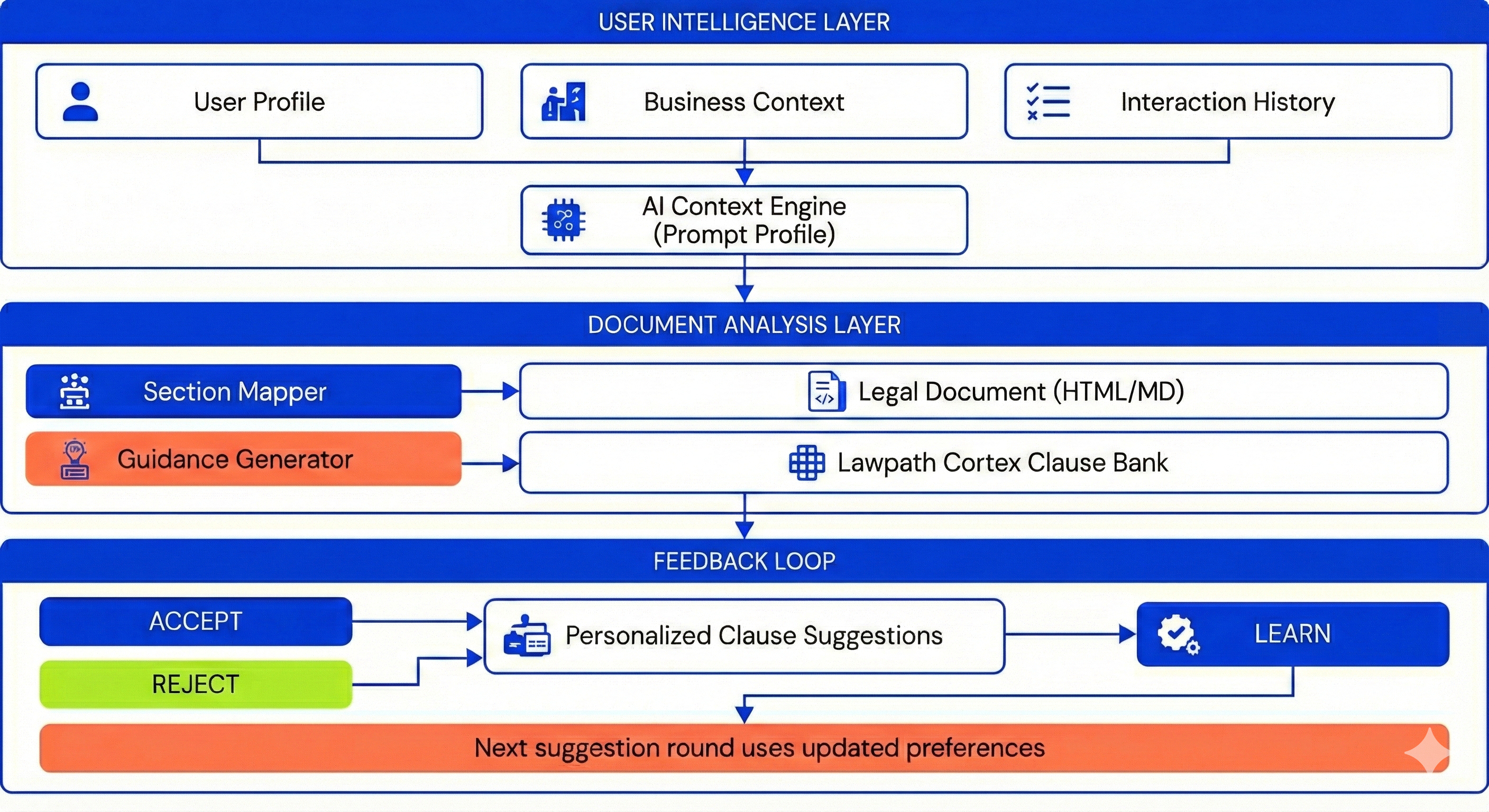
Here’s how the system brings together your context with AI analysis to generate personalised clause suggestions:
Your business profile, industry context, and past preferences feed into the analysis engine alongside the document itself. The AI doesn’t just analyse the document in isolation. It analyses it in the context of who you are and what you need.
This architecture ensures that every suggestion you receive is informed by who you are, what your business needs, and how you’ve responded to previous suggestions. The result is a genuinely personalised legal drafting experience.
Retrieval-Augmented Generation for Accuracy
One of the challenges with general-purpose AI tools is hallucination: the tendency to generate plausible-sounding but incorrect information. This is particularly dangerous in legal contexts, where incorrect advice can have real consequences.
We address this using retrieval-augmented generation (RAG), an approach that grounds AI responses in verified source material. As Pablo Arredondo, Co-founder of Casetext (now part of Thomson Reuters), explained: “We leverage technology but anchor it in truth, using retrieval augmented generation, where AI bases its answers solely on the real case law we provide.”
Our Document Editor follows the same principle. Suggestions are grounded in Australian legal requirements, established drafting practices, and your own business context. The AI doesn’t make things up.
What This Means for Your Business
The Lawpath Document Editor represents a significant step forward in making professional-quality legal documentation accessible to Australian businesses of all sizes:
Reduced risk: Identify potential issues before they become problems. Unfair contract terms, missing protections, regulatory gaps. The editor surfaces these so you can address them proactively.
Time savings: Get intelligent suggestions instantly, not after days of waiting. Industry research suggests AI can reduce first-draft time from hours to minutes for routine contracts, with one study finding a 98% reduction in draft time.
Cost efficiency: Access legal intelligence without the traditional legal bill. This doesn’t replace lawyers for complex matters, but it means you can handle routine contracts confidently without engaging external counsel for every document.
Confidence: Know that your documents have been analysed against Australian legal standards. When you send a contract, you can be confident it’s been checked for common issues and regulatory compliance.
Getting Started
The AI Document Editor is now available to Lawpath members. When you create or edit a legal document on the platform, you’ll automatically have access to intelligent suggestions, risk assessments, and personalised guidance.
For businesses that want to take full advantage of these capabilities, our legal advisory plans provide unlimited access along with the ability to consult with our legal team when you need human expertise. Because while AI can surface risks and suggest improvements, there are times when you need a qualified lawyer to review your specific situation.
We believe this is just the beginning. As AI capabilities continue to evolve, we’re committed to bringing the most advanced legal technology to Australian businesses, making professional legal guidance accessible to everyone who needs it.
If you have feedback on the Document Editor or suggestions for future improvements, we’d love to hear from you. The best features often come from listening to the businesses we serve.
References
-
Richmond Journal of Law and Technology. (2024). “AI in Contract Drafting: Transforming Legal Practice.” jolt.richmond.edu
-
Horkoff, J., et al. (2023). “Transparency and Explainability of AI Systems: From Ethical Guidelines to Requirements.” Information and Software Technology. sciencedirect.com
-
ACCC. (2023). “Businesses Urged to Remove Unfair Contract Terms Ahead of Law Changes.” accc.gov.au
-
Ksolves. (2025). “Enhancing Legal Document Analysis with NLP.” ksolves.com
-
Spellbook. (2025). “AI Legal Document Review: How AI Enhances Contract Analysis.” spellbook.legal
-
Virtasant. (2024). “AI Contract Management: 80% Time Savings in Legal Work.” virtasant.com
Tran Le, AI Engineer, Lawpath